

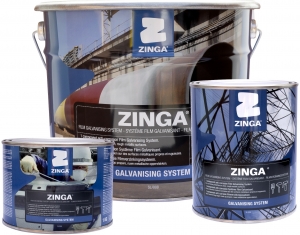
In contrast to a paint layer, a galvanisation layer is itself a metal product. It is therefore just as flexible as metal. Mechanical shocks will not jar the galvanisation layer loose or make it chip off, or cause scratches or insidious rust formation underneath. This would make thermal galvanisation or hot-dipping a full-fledged competitor for ZINGA®. But thermal galvanisation also presents serious drawbacks. It requires a special installation. Existing structures must be dismantled in advance, which adds considerably to the cost price. It is a complex and sometimes dangerous procedure, using zinc that is heated as high as 420°C. Other systems such as metallisation, anodising, and sherardising also lack the unique properties that ZINGA® possesses.
ACTIVE PROTECTION?
Thermal galvanisation
ZINGA®
Only the top alloy layer of hot-dip contains more than 96% zinc.
A layer of ZINGA® has a concentration of 96% zinc, pure to 99.995%. Moreover, ZINGA® is the only liquid galvanising protection that is based on special zinc dust pigments. Tests, e.g. the salt spray test performed by the Productivity and Standards Board in Singapore, have proven the superiority of ZINGA® in comparison to hot-dip galvanisation. A field test of the French Maritime Service has proven very clearly that Zinganisation is more efficient than hot-dip galvanisation. Details on these tests can be found under the chapter "Certificates & reports".
PASSIVE PROTECTION?
Thermal galvanisation
ZINGA®
Hot-dip does not provide a supplementary barrier protection. There is only a very small formation of zinc salts on the surface.
A layer of zinc salts slowly builds up on the ZINGA® surface. This creates a barrier protection for the metal substrate. Next to this, a supplementary barrier protection is provided by the binder in ZINGA®. The binder reduces the disintegration of the zinc.
EASY APPLICATION?
Thermal galvanisation
ZINGA®
Hot-dip galvanising includes dismantling of the structure, transportation to the workshop, re-welding, reconstruction, etcetera. This costs a lot of extra money. Moreover, not every kind of steel is suitable to be treated at such high temperatures (starting from 450°C). An analysis of the steel is required first. Immersion may cause permanent deformation of the structure.
ZINGA® can be applied in the same way as a paint. Galvanising with ZINGA® can be done on the spot. There is no need to dismantle the structures or to bring them to a workshop with a sophisticated installation. It is now possible to galvanise any metal structure without the help of specially trained craftsmen. You have complete control over the management of your production process or maintenance work. There’s no risk of deformation of the structures when using ZINGA®.
APPLICATION IN BAD WEATHER CONDITIONS?
Thermal galvanisation
ZINGA®
Work is being done in the workshop.
ZINGA® can be applied in a humid atmosphere. What is more, humidity even has a positive influence on the curing of the layer.